Day 7

Saturday, March 30, 2013

Saturday is Dallas day.  We got ourselves out, went to the 6th Floor Museum, then moved to the Nasher Sculpture Park and then spent some time in the Dallas Museum of Art.

The Sixth Floor Museum is in what was the Texas School Book Depository building, where Lee Harvey Oswald made himself famous by shooting President Kennedy in 1963.  The museum is situated on the 6th and 7th floors, with the rest of the building not open to the public (owned by a governmental agency with their offices).  The exhibits first take you back (in our case) or to (in the case of those who were not alive at the time) the Jack Kennedy era, starting with some biographical information on him.  The main exhibit starts really, however, with JFK’s running for the Presidency in 1960.  It recreates the times – books that were out then (e.g., To Kill a Mockingbird,  Rise and Fall of the Third Reich), movies extant (e.g., La Dolci Vita, Spartacus, Psycho), and the music of the era (Elvis Presley, Chubby Checker (the Twist) and the Drifters top the singles charts for the year).  It doesn’t go into the politics of the time (Quemoy and Matsu, for example), rather it talks about the youth of Kennedy as he wins and assumes office.  The politicians that preceded him into the White House had been elder statesmen, while he is a young man with a beautiful wife and young children.  His energy is especially emphasized, and his youth compared to his predecessors.

Events during his days in office included the Cuban missile crisis, which scared all of us around at the time terribly, but as it turned out, enabled him to earn the respect of Kruschev and the broader world.  He sponsored legislative initiatives in civil rights and the establishment of Peace Corps.   This started a whole new consciousness of what can be done for others in places beyond our borders.  It enabled individuals to serve and through their service, the US to broaden its influence overseas on a people-to-people basis, rather than through political channels.  It made specific what he meant by his statement, “Ask not what your country can do for you, but what you can do for your country.”   Then there was the response to sputnik, with Kennedy’s challenge to the nation to have a man on the moon and back to earth by the end of the decade.  And the wit and charm of Kennedy, with examples from his press conferences.  This of course gets us back to the optimistic feeling of the early 1960’s, a time of challenge, but a time of incredible opportunity as well.

Then we are taken to the last trip to Dallas, where Kennedy is on a visit to shore up his candidacy for a second term.  After a short flight from Houston, the president and Mrs. Kennedy land at Love field, and are taken on a 10 mile tour around central Dallas aimed at arriving at the Dallas Trade Mart at about 12:30 pm to have lunch with invited guests.   We then are shown through pictures and sounds the events of the fatal seconds as Oswald fires his rifle three times from his 6th floor perch.  Kennedy is rushed to Parkland Hospital, but is pronounced dead shortly after arrival.  Governor Connelly, who with his wife were in the “jump” seats of the Lincoln Continental presidential car, was hit by one of the bullets, so he also had a stay at Parkland, was operated on there, and eventually recovered.

The next areas talk about the investigations into the assassination.  There were many, starting with the Warren Commission, and lasting until Assassination Records Review Board finished releasing what it could release of the documentation and evidence in 1998.  All further documentation (there are only tax records and other private materials left unreleased) will be released in 2017.  The investigations did not come to identical conclusions.  Some agreed with the Warren Commission that either Oswald worked alone.  Later ones suggested Oswald worked as part of a conspiracy with conspirators unknown, but not the CIA, FBI, Secret Service, Russian government, KGB, Cuban government, mafia.   The conspiracy theories seem hard for people to let go of, and of course with Oswald shot by Jack Ruby, it is impossible that a final resolution will ever happen.  Exhibits included the cameras that took pictures useful to the investigations (the Zapruder film, the most definitive of the pictures as it was taken continuously through the time of the first shot until Kennedy and group were driven away to the hospital, was taken on a camera very much like the one on exhibit, but the actual one was preserved in the National Archives), a discussion of all the forensic evidence, (there is a “single bullet theory” which accounts for Gov. Connelly’s wounds as being caused by the first bullet fired, after it had gone through Kennedy’s throat and out the front of his upper torso by his tie, and then proceeding to go through Connelly’s chest shattering a rib, through his wrist (shattering one of his forearm bones), and lodging in his left thigh.  The angles bear this out, and the only argument against is that the bullet remained in its initial shape rather then being misshapen as a result of its various interactions with Kennedy and Connelly.

After this, the reaction of the world is considered, with a surprising collection of film from around the world showing reactions in countries and cultures too numerous to mention, all of it expressing shock, surprise and sadness at the death of Kennedy.  Lastly, a discussion of the legacy of Kennedy’s 1000 days in office recaps the things he initiated, and discusses briefly the impacts some have had to date on the history of the US and countries around the world.  It is very well done.  The ability to see in a fairly short period of time the results of the investigations into the assassination and the various commissions helps put in perspective the likelihood that it was the work of one man only, rather than a conspiracy.

The ability to see the vantage point of Oswald also helps corroborate the notion that he was a lone shooter (they even have white X’s painted on Elm St where the car was with each of the two main shots.  But the conspiracy notion lingers, and so the question is asked, and of course not really answered as to why so much interest in the notion of a conspiracy?  As my father was wont to say about conspiracy theories, they require much more cooperation and ability to keep a secret than mankind is usually capable of.  But there seems to be no end to the need to investigate them.  In the later investigations, the open microphone of one of the police motorcycles recorded in the precinct station was analyzed to try to determine how many shots were fired.  At first, it appeared to document more than the minimum three shots, thus leading credence to the notion of a second shooter, perhaps on the grassy knoll.  Eventually, however, it was decided (and verified through experiment) that the multiple report sounds were in part echoes off the buildings surrounding Dealey Plaza.

The exhibits allowed Gwen and me to think back to what we were doing when we found out about the assassination.  I was in a high school classroom (English, I think, but it could have been French class).   The intercom just came on, something that never before happened, broadcasting radio reports directly through to the whole school.  Strange, and then the words started to make sense, horrible sense, and eventually, we were instructed to go home.  Gwen’s school was not up to intercoms yet, so there were messages passed to each class, read by the teachers to the students.  The classes were not sent home early but kept at the school with teachers roaming from group to group crying and talking until the normal end of day.

A very good opportunity to think about those times again.

The next step was to go to the Nasher Sculpture Center.  This was in the same complex as the Dallas Museum of Art, the Museum of Asian Art, and I suspect there is also a Museum of Modern Art there as well, but that may just be my poor memory.  The Nasher was hosting an exhibition of works by Ken Price, a contemporary artist that specializes (at this point) in three-dimensional objects with color on the surfaces.  The central piece looks like a multi-toed foot where the toes surround the central core, each the same size, each appearing to have been a large drop coming down from the top of the figure and ending up where it is.  The object is colored in a primary color (blue, red, etc) with splotchy speckles of one or more different colors to give a common array surface effect.  In the exhibition were a number of such objects of various sizes, built on a similar theme.  He also had a number of glazed, multisided boxes.  These “boxes” were small (my memory says nothing more than a foot in any one dimension).  The depth of color was created by a large number of glaze coats applied to the figure, and then meticulously sanded down to smoothness and clarity.  This is supposed to be a very time-consuming process, but the result is beautiful in color, even if the boxes themselves lack the “beauty” of a recognizable functional purpose.  There were some more examples of his work on the floor below.   Included are a series of landscape paintings at sunset, which I enjoyed.  The colors are exaggerated, and the forms are recognizable.  The effect for me was one of emphasis, and I was taken by the way it brought to life the impression of a colorful sunset; the way the colors are seen in my mind’s eye after the sunset disappears – each color is bright and identifiable, the colors enhance the outlines of the things that reflect that color.

We went outside and walked around the garden area.  This area is large enough to house a number of sculptures among the grass and trees.  I am not a fan of the I-beam sculptures, but every such garden must have one, it seems, and this one is no exception.  A grouping of six or so life-size people entitled something like “the Crowd” was intriguing.  A pair of rusted steel panels, inches thick, curved in an arc from side to side, set in such a way as to create a narrowing gap from bottom to top created the illusion of walking into a cave as one passed through the gap between them.  A water fountain is set on the wall near the café.  The water comes out of a dozen same-size holes drilled in marble set at the same height above the pond.  A set of human shapes in rows, with no heads but dressed for rain provided an interesting grouping.  The shallow pond along the back side of the garden was soothing, and the regularly spaced foot-high fountains added energy, but in a soothing way.

We bought a lunch in the cafeteria (very good sandwich and chips) and sat out on the back patio overlooking the garden to eat it.  Definitely worth the visit.

Afterwards, we walked to the Dallas Museum of Art, and attempted to take it in in a couple of hours.  It is an eclectic, but interesting collection, housed in a fascinating structure that more or less forced the viewer to see (or more accurately scan) the whole of the exhibits before getting to any particular place or time.  I was enchanted by the furniture (mixed with other paraphernalia) exhibits, with some marvelous pieces dating back to the 1700s and made in the US.  Some great craftsmen existed here, and plied their trades successfully.  There is quite a collection of International art, including South American, Asian, as well as various European and Middle Eastern art.  They have whole rooms set up as one would have seen them in the 1800’s; an interesting peek into how people (with money, of course) would have lived in those times.

We saw a lot, enjoyed it, but left to get ready to see Dave and Linda Letts.  Linda had invited Charlotte and Barbara, two good friends to come along, and we met at an Arlington Middle Eastern food place, where Dave thought we could enjoy the food, and sit and talk.  We did, the food was very good, and the company was better.  Gwen had a great time with the women, while Dave and I got to catch up.  Dave was kind enough to give me a very nicely done picture of The Audley pub in London; a place we enjoyed on many occasions after our meetings in the Park Ave office.
2 Comments

Filed under Uncategorized

Day 6

Friday, March 29, 2013

Friday was another travel day, like Thursday.  We got up early enough to get on the road and head to Dallas area with time to spare when we got there to look at one of the Ft Worth Art Galleries (Kimball), which was having an exhibition of Bernini’s clay models.

The scenery hadn’t changed.  It started out with farm land all around, but after awhile, the scrub brush (like California) appeared (juniper tree variety), and seemed to follow on one side or another all the way into Dallas/Ft Worth.  The towns kept coming one after another about every 8 to 10 miles.  The road we were on, however, maintained its dual highway status, so the speed limit got up to 75 for the most part.   The definition of ‘freeway’ in Texas (and OK, and even in AR) seems to be a little different from what I’m used to in CA and MI.  I’m used to freeway meaning a limited access road, but the roads in TX with the 70 or 75 MPH limits were not limited in access.  There were crossing roads, entrances directly from driveways, entrances and exits that cross lanes of opposing traffic.  (OK, when they cross the opposing traffic, that traffic has a “yield” sign.)

We got to our hotel in Arlington, looked at what was available to do, and found that the Kimball Museum in Ft Worth, with the Bernini exhibit, was open until 8:00 in the evening.  We decided to try to find a good steak ahead of going over, as it was about 4:30.  So, over to Ft Worth we went. The TripAdvisor website indicated that the best steak was at Del Frisco’s, so there is where we went.  What we didn’t know was that this is a gourmet place; but that was all right – we wanted a good Texas steak.  Gwen got the Filet Mignon, and I got Osso Buco; a good choice, but not as good as the Filet!  We got in because we were there before they really opened (at 5:00), and were able to get out of there before 5:45, enabling us to get to the exhibition at about 6:00.

We went into the museum, and I don’t know what Gwen expected, but I was surprised at what we saw.  Bernini was a great 17th century Italian sculptor, and was responsible for much of the fountain sculptures in Rome.  It is of course not possible for the exhibit to bring over the finished products, so they did the next best thing – showing the clay models still extant made by Bernini to show his customers what he was planning, and in their refined form, to be used by the sculptors who worked for him to help him translate design into the finished marble product.  The final model, no larger than three feet tall, was measured and expanded to generate the larger than life statues and collections of statues that ended up all over Rome, including St Peter’s, as well as the public fountains.  The exhibit was very well done, enabling me to learn a lot in a short time about the models, the approach Bernini used (he used clay, as well as drawings by the hundreds to develop his ideas, something not all other sculptors do), and to show the unsuccessful ideas as well as the successful ones.

In addition to the tour of this exhibit, we took a brief tour of the other elements of the Kimball’s collection on display, and then came back to the hotel.  We agreed that the Kimball is a great boutique collection.

Leave a comment

Filed under Uncategorized

Day 5

Thursday, March 28, 2013

Travel day from Santa Fe to Lubbock, TX.  This was one of the more boring days of the trip, as the countryside was for the most part not particularly scenic or colorful.  Gone were the great promontories overlooking our drive from the left as we were traveling through.  The land was flat, or almost so, with only the occasional hill to relieve the visual similarity.  The early part of the trip still had some of the junipers in great fields, and, of course, the trains kept us company as we went along, but the junipers gave way to grassy fields with the occasional greenery interwoven in, and the fields became farms.

Most of this trip was through New Mexico, although the last 88 miles were through Texas.  One thing that really struck me was that almost as soon as we got into Texas, just beyond Clovis, NM, the ranches / farms immediately were all dominated by the huge above-ground extended irrigation pipes set up triangular supports.  Each support had wheels at their bases to enable the whole to move across the fields. These structures were not part of the landscape in NM, but once in TX, there was not any point in time where at least one wasn’t visible, or so it seemed.

The towns are located at regular distances from each other, once we got into Texas.  We travelled on the US 84, not the interstate (I40), as it was quicker and while the road was not divided highway, it had a 65 MPH speed limit on it, and the distance was considerably shortened by using these roads.  While I am mentioning speed limits, AZ and NM have 75 MPH limits on their divided highways, without seeming to differentiate for trucks.  Thus trucks sped along at a great rate.  Texas seems to continue that policy, but their top speed appears to be 70 MPH, like California’s.

We got to Lubbock, and after getting a late lunch, we decided to go see the Buddy Holly museum.  It is a very nicely set-up museum, and described with relevant paraphernalia on exhibit the life and impact of Buddy Holly.  It was interestingly done, with description, and almost a day-for-day record of Buddy’s activities in his professional music life.  It was a very short one professionally (18 months from the signing with Decca records to his untimely death in an airplane crash), but he was a musician / songwriter from a very young age.  The thing I didn’t know about his history was the impact he had on those who followed him.  The museum makes it clear that the approach to rock music that followed was heavily influenced by him.  Paul McCartney, Keith Richards, Bob Dylan, among others all spoke about how the way he handled his guitar, and the way his songs were structured, as well as the way his group (the Crickets) handled the music was so striking that they emulated it in their initial music.  Buddy and the Crickets did tours in England and Australia, which solidified their international reputation, and enabled those who came after to watch him in action.

We came back to a suite at the Holiday Inn Express here, and have been enjoying ourselves trying to figure out what we will see in Dallas/Fort Worth tomorrow and Saturday!

Leave a comment

Filed under Uncategorized

Day 4

Wednesday, March 27, 2013

Today is Santa Fe day.  We visited the Museum of International Folk Art (on Museum Hill), saw the oldest Church in the continental US, and walked around the central town square area, where we got our lunch.

The Museum of International Folk Art is different from what I usually expect in a museum.  They have picked a few themes, and have dedicated a wing to each.  Today, they have a wing devoted to HIV/AIDS education (with a lot of expected participation aspects), a wing with exhibits concerning the culinary aspects of living in NM through the years, especially ideas, equipment, furniture and utensils related to cooking, chocolate, and a drink popular in South America called Yerbe Mate and two wings which is focused on international folk art.

The HIV/AIDS exhibit was OK, but didn’t excite me much.  There is a lot to learn here, but an exhibit focused on drawing attention to the issue is not something I need to spend time on.  The culinary exhibit, on the other hand, really got my interest.  Basically, the aspect that caught my attention relates to the history of the culinary dishes, and how this has changed with major events in the world’s history.  A point they make right in the beginning is that many of the products we take for granted now were sourced in the Americas, many were sourced in Europe, and many in Asia, Africa, and the Near East.  This eventually was (at least partially) the impetus for much of the world trade in foodstuffs even right up to today.  We know about the obvious ones – tobacco from the Americas went to Europe as a result of the discovery of the Americas by Columbus, along with tubers like potatoes, squash, and others, avocados, corn, and so on.  Europe provided beef, and other resources to the Americas, while Asia was the traditional source of spices.  Chiles came from the Americas, as did chocolate.   Tea came from China originally; coffee is from the Near East.  In the centuries after Columbus, a brisk trade developed from Europe to Central America to Asia, and back, moving lots of these commodities back and forth.  It also opened opportunities for the development of new types of foodstuffs, combining these items into dishes that brought out the best from each ingredient.

Sante Fe NM 1  102

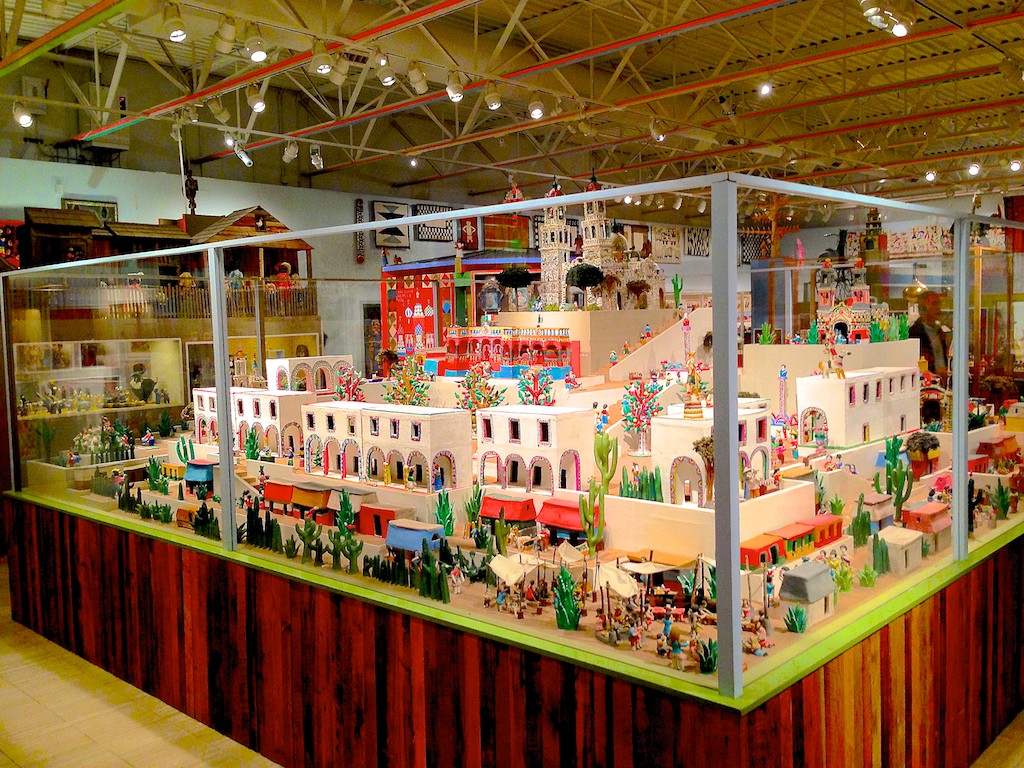
One of several model villages

Sante Fe NM 1  101

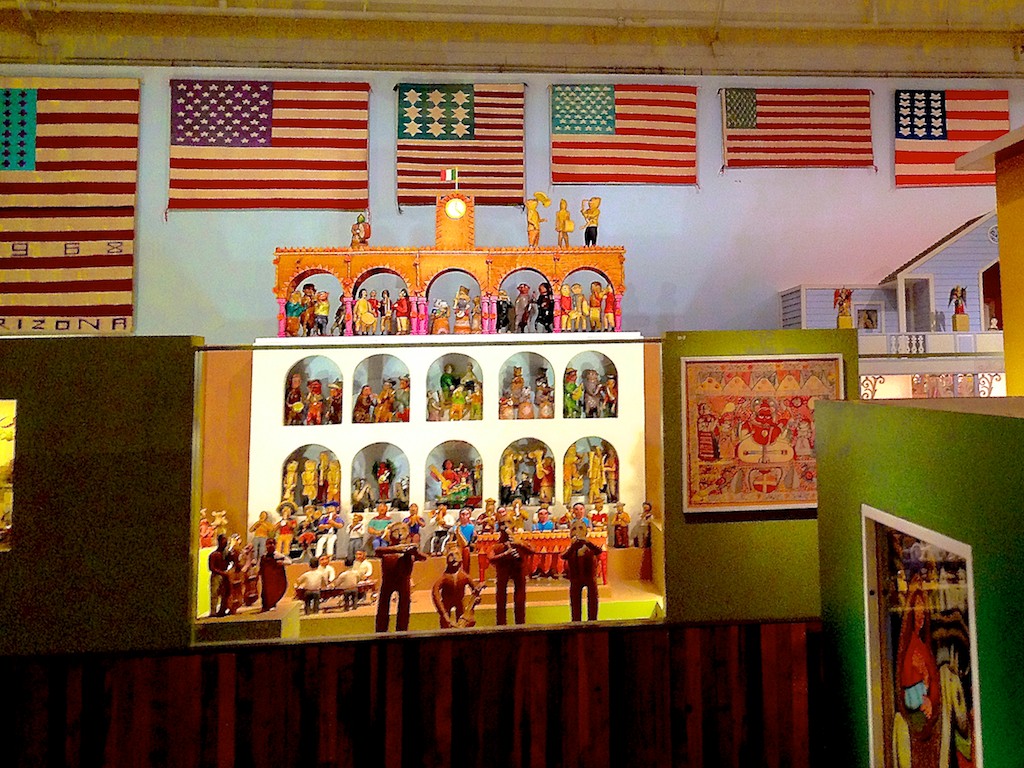
Various people’s conception of our national symbol

Sante Fe NM 1  103

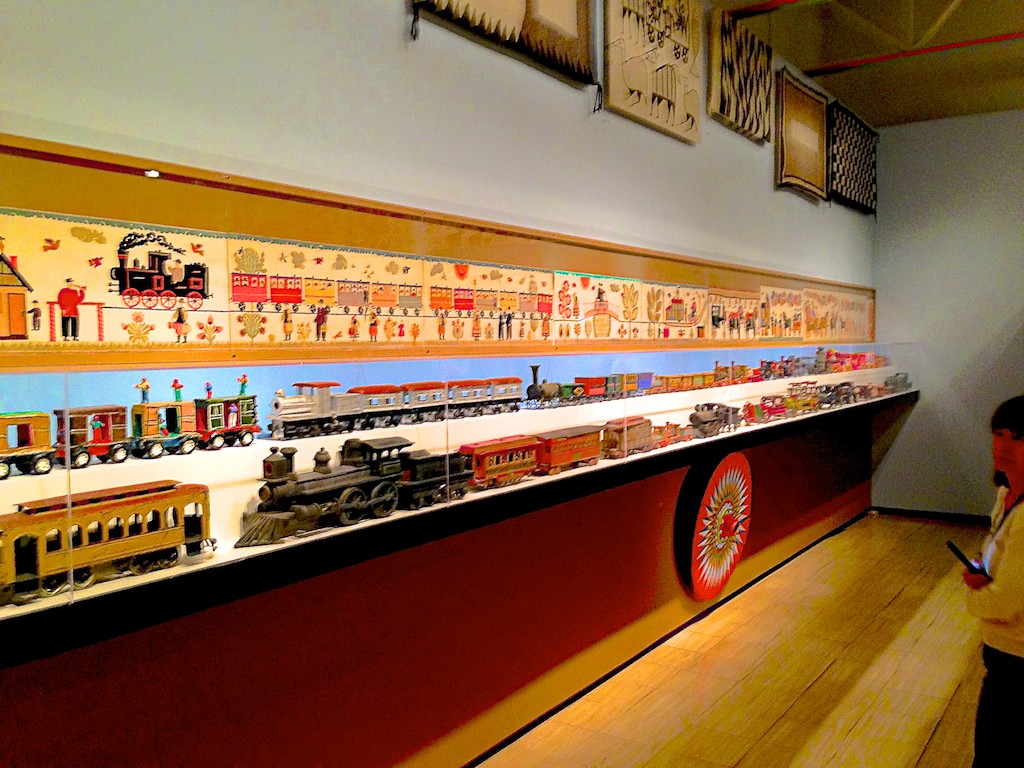
Locomotion devices

Sante Fe NM 1  100

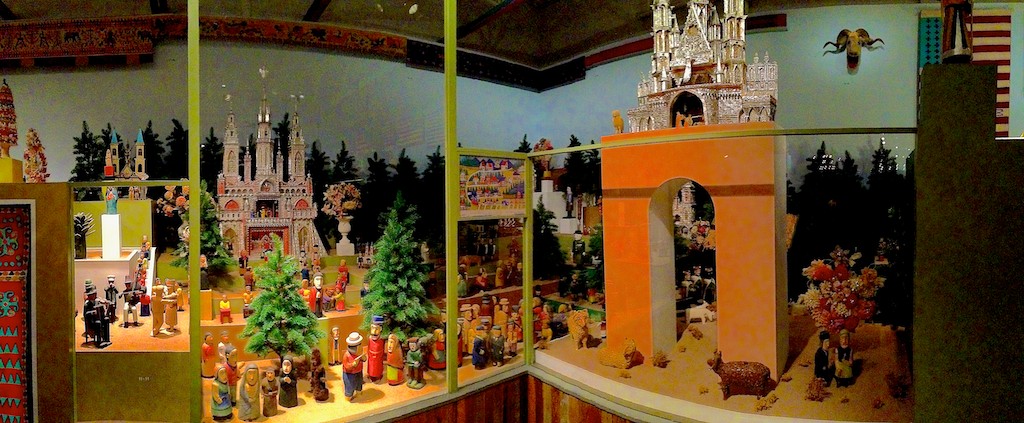
Polish Christmas story settings

The international folk art wing contained two exhibits we saw.  First was a variety of quilts by Amish societies around the US, made from the early 1800s to modern day.  These quilts were based on patterns established by the families, and in most cases were geometric in basis.  (Tessellations come to mind in thinking about them now.)  They represent a great deal of work, and in most cases exceeding skill in making them.  They come in sizes from doll-crib to adult bed size.  The other exhibit takes up an entire gallery, and is named for the major donor, Alexander and Susan Gerard.  They started out collecting folk art in the 1930s, and when they came to Santa Fe, they became very interested in the museum, donating much of their extensive collection to the museum in the early 1970s.  At that point, their contributions effectively quadrupled the size of the museum’s collection.  Alexander Gerard, who was an interior and textile designer of considerable repute, had grown up in Italy with an Italian father and American mother, educated in architecture in Rome, and practiced in Florence and New York before coming to Santa Fe.  The exhibit, set up by Mr. Gerard himself in the 1980s shows off more than 10,000 of the items, but the total collection consists of over 100,000 items.  Some of the highlights: US flags of various sizes, with various ways of depicting the stars in their area of the flag against the strips; a collection of model transportation items (cars, buses, trains, carts, etc.); Polish Christmas scenes with multistory toy castles with shiny aluminum fronts used as stages around Christmas time to enable the playing of various Christmas-like stories; street scenes of various originations showing markets and people milling in those markets; stitchery practice, where youngsters would stitch alphabets in a variety of calligraphic patterns (fonts); river front scenes made up of a variety of dolls, boats, and buildings set on wooden blocks serving as elevation delimiters; and a fascinating sectioned-off area where many religious (Christian) folk art were shown.  Fascinating stuff.  Lessons from this exhibition – folk art is not art in its most perfect form, but art indicative of individual skills at trying to convey a message, or create something functional.  There’s hope for my painting yet!  Another lesson: exhibits with lots of words rather than being organized to bring their message across visually are apt to be lost in the words.  It was a fun exhibit, with lots to learn, and lots to see.  Another aspect: you don’t have to like all of folk art to like some of it.  You don’t have to like folk art to acknowledge its value in telling a story or capturing history.

Sante Fe NM 1  104

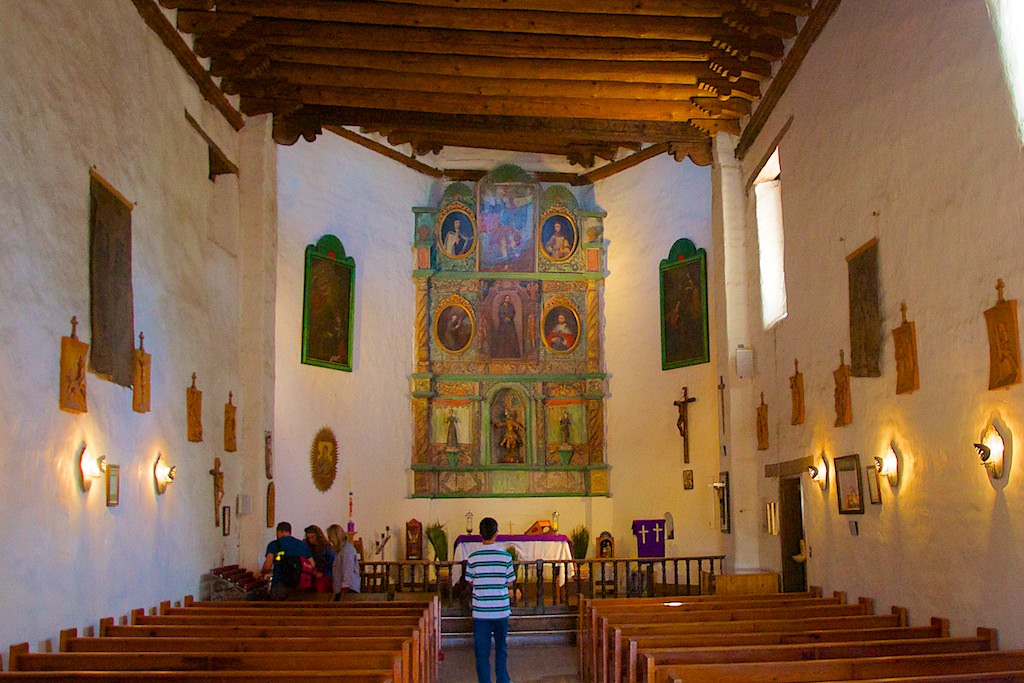
San Miguel Chapel, oldest chapel in US

From the International Folk Art Museum, we went to the downtown (old town) area of Santa Fe.  Our first visit there was to the oldest church in the US. a Spanish colonial mission church built between approximately 1610 and 1626.  Though the church has been repaired and rebuilt numerous times over the years, its original adobe walls are still largely intact despite having been hidden by later additions.  At the front of the chapel is a plexiglass-covered cut-out in the floor enabling the viewer to see the original 1610 foundation, as well as footings for an Indian dwelling that has been dated to 1300.  A bell looking to be half the size of the Liberty Bell sits in the back of the church for people to ring as desired.

Sante Fe NM 1  105

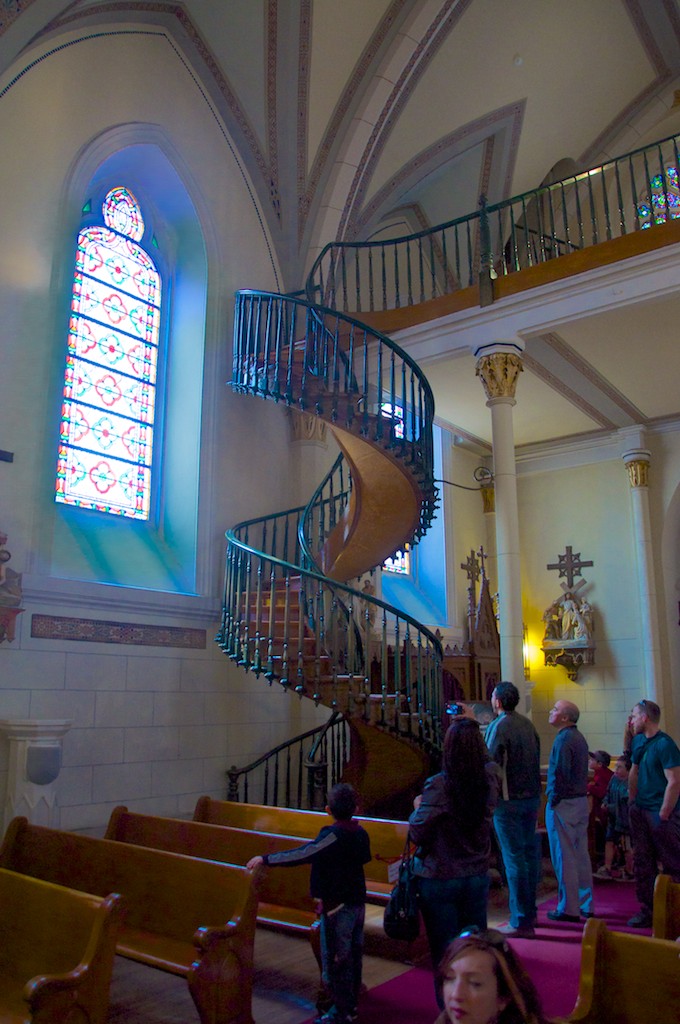
Stairway in Loretto Chapel

Right next to the chapel is a building claimed to be the oldest residential building in the US, built around the same time as the chapel.  Unfortunately the docent was not there, so we didn’t get to see inside.  We walked down the road from there, and happened upon another building related to the Catholic religion — the Loretto Chapel.  This one, built between 1873 and 1878, was originally home to an order of nuns.  The item of interest in this chapel is the circular stairway built to enable the sisters to gain access to the choir loft at the rear of the chapel.  The stairway confounds architects, engineers and master craftsmen to this day.  It makes over two complete 360-degree turns, stands 20’ tall and has no center support.  It rests solely on its base and against the choir loft. The risers of the 33 steps are all of the same height.  Made of an apparently extinct wood species, it was constructed with only square wooden pegs without glue or nails.

My understanding of the story is that after the chapel was built, the sisters realized that the ladder to get to the balcony was inconvenient and hazardous.  Just as the nuns were looking for help with this project, a young carpenter showed up looking for work.  The circular staircase was completed in about six months time, in any case, before 1883.  The young carpenter then packed his tools and left, collecting money neither for his time nor for the cost of the wood.  The banisters were added in 1887, although the carpenter this time was paid for his skillful work.  The chapel was eventually determined to be redundant to the needs of the nuns, and eventually was sold into private hands (in 1971).   It is still used for weddings and other appropriate occasions.

Sante Fe NM 2  012

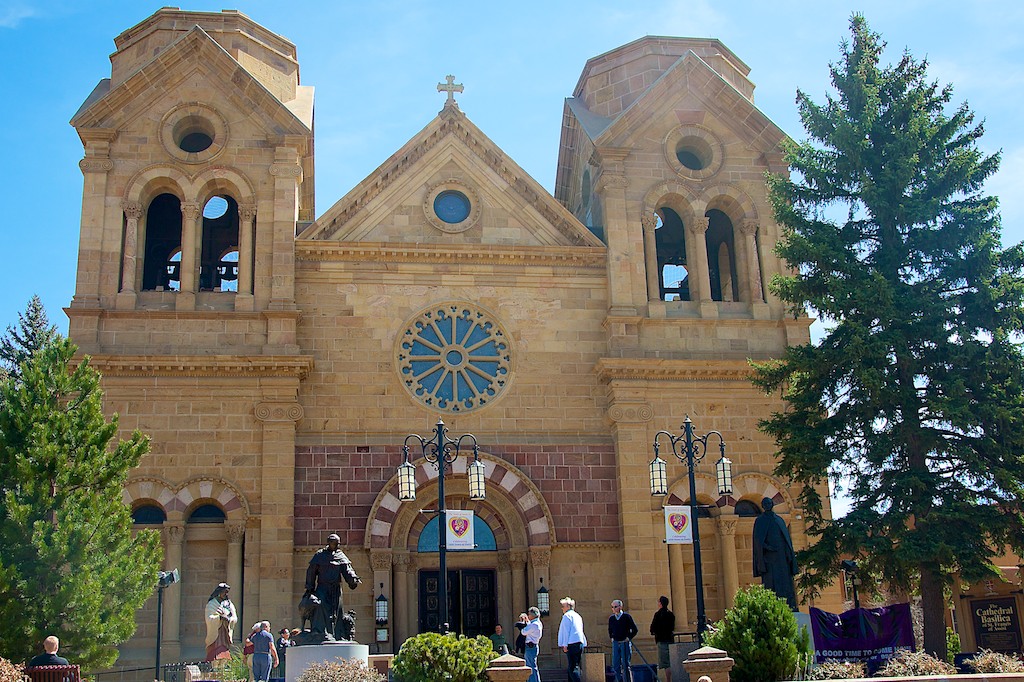
Cathedral Basilica of St Francis

After an interesting lunch in a French café (featuring crepes) in the old-town area, we walked to the Cathedral Basilica of St Francis, consecrated in 1886.  This is a much larger structure than the others, and is still a going concern.  It was designated a Basilica in 2005 by Pope Benedict XVI for its role as the “cradle of Catholicism” in the Southwest US.

A short walk from there took us back to our hotel.  This place is a boutique hotel (the Inn on Alameda) right in the heart of Santa Fe, and was a great find on Gwen’s part.  It served wine daily at 4:00, along with veggies and dip, and thus enabled us to eat our big meal at breakfast and lunch and to just gobble their free-by’s at dinnertime.  Their breakfasts were quite good, and included, in addition to the usual fare, quiches and other more exotic egg dishes.  It was sad to only spend two days there, but we’ll be back, I suspect!

2 Comments

Filed under Uncategorized

Day 3

Tuesday March 26, 2013

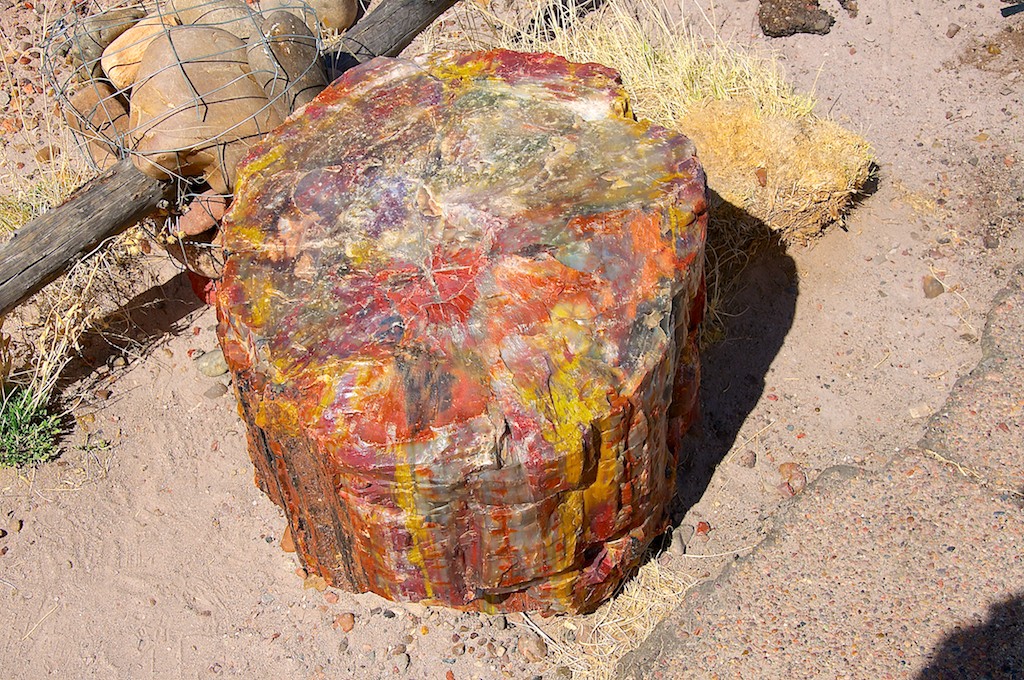
Petrified Forest 1  014

Cut and polished petrified log in the Rainbow Forest Museum

Today was a driving day – the objective: to get from Flagstaff, AZ to Sante Fe, NM.  Again, mostly driving the I40.  Part way across Arizona, we discovered the Petrified Forest and Painted Desert.  Wow – what a discovery!  Per the travel websites Gwen likes, we cut off of the I40 early, and drove the 20 miles down the US 180 to the southern end of the Park.  Turning left into the park, the first thing we came upon was the first of three Ranger Stations.  This one, the Rainbow Forest Museum, has a very well-done exhibition of dinosaurs and other bones found in the park.  It also had an explanatory video showing the history of the place as currently understood.

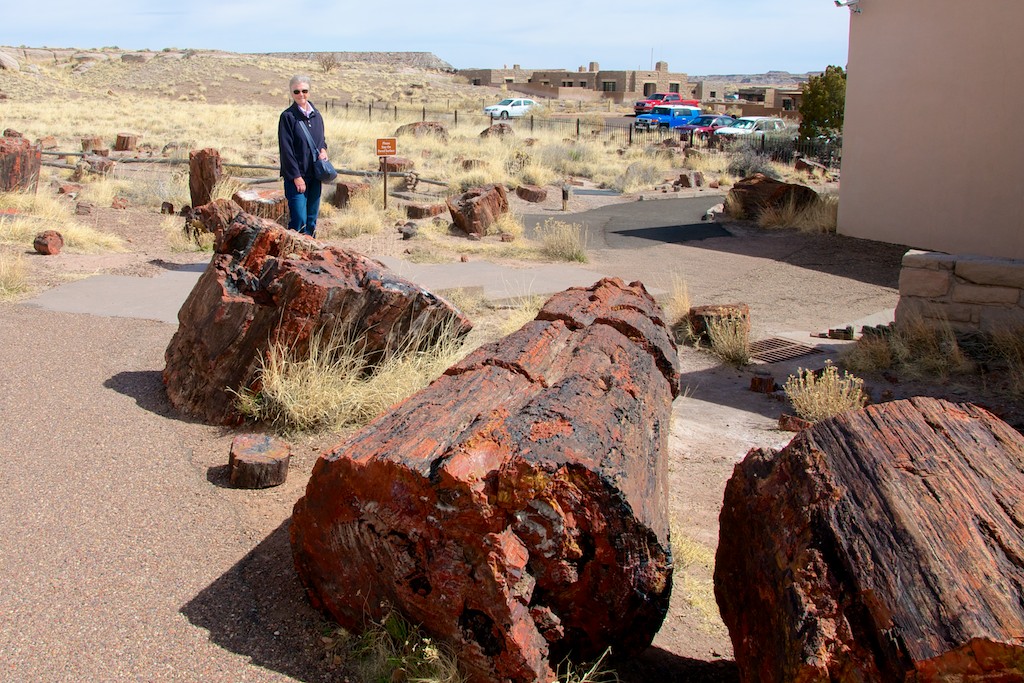
Behind the museum is a field of petrified logs, with concrete pathways to follow.  We took a circular path of about a quarter mile and passed by quite a few multi-colored logs strewn in no pattern to be discerned.  I’ve seen petrified wood before, but never in such quantify, and in such colorful variety.  Large logs as big around as Gwen down to small chips of rock hued in dark reds, purples, yellows, whites, and grays.  Some were very long, along the path, some sitting on end.  Petrified Forest  021 Petrified Forest  020 Petrified Forest  023We later were to learn that the colors are determined by the chemistry of the silica crystals that replaced the wood fibers.  From the handout booklet, “Petrified wood’s varied colors came from minerals in the silica-saturated waters.  Iron, carbon, manganese, and sometimes cobalt and chromium produced patterns and blends of yellow, red, black, blue, brown, white and pink.”  Really beautiful patterns of all kinds, but all obviously following the original wood structure.

Petrified Forest  032

The TeePees

We carried on into the park, driving by hills that are colorfully striated: red, white, and a variety of browns and grays.  Petrified Forest  029 We thought this was the Painted Desert, and it certainly is related.  Turnouts are provided in several places, and we took advantage of most of them.  One of the first was on the edge of another field of petrified wood logs.  Lots to see in all directions.

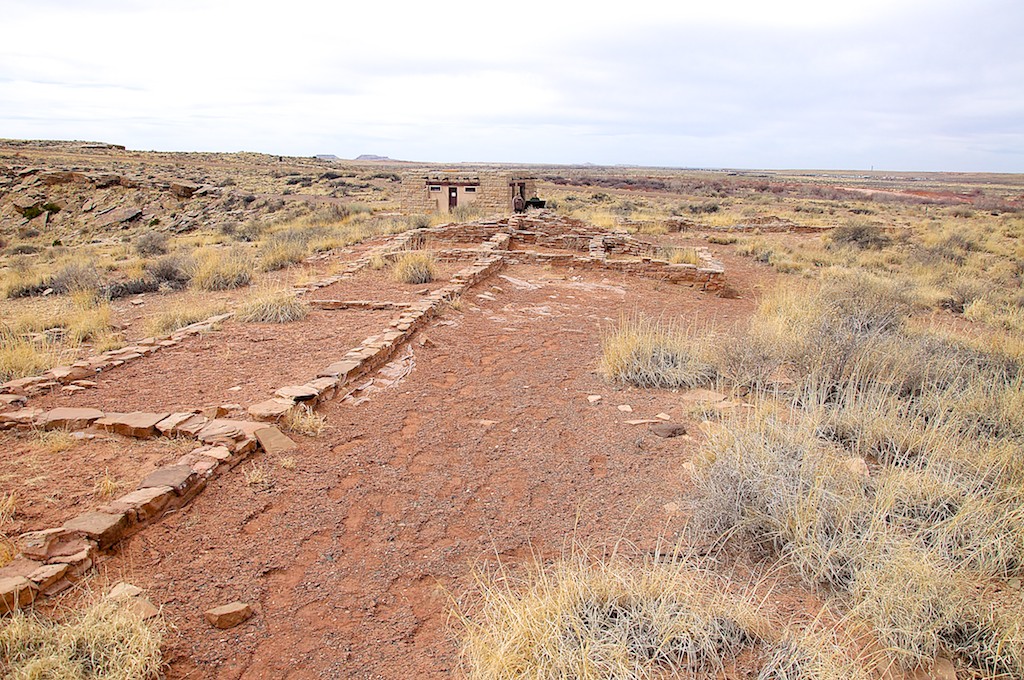
I took plenty of pictures as Gwen drove through the park.  The other aspects of interest included human habitation, the petroglyphs, and lastly, the designated Painted Desert.  There is ample evidence of human habitation, dated first from the 1100’s, and then from the 1300’s, but when the Spanish explorers came through in the 1540’s, human habitation had disappeared. Petrified Forest  037

The remnants were building foundations, which showed small rooms around a central court.  Nearby are rocks with black areas that have been chipped out into petroglyphs.  While not obviously identified, the petroglyphs indicate that the inhabitants were hunters as well as farmers.

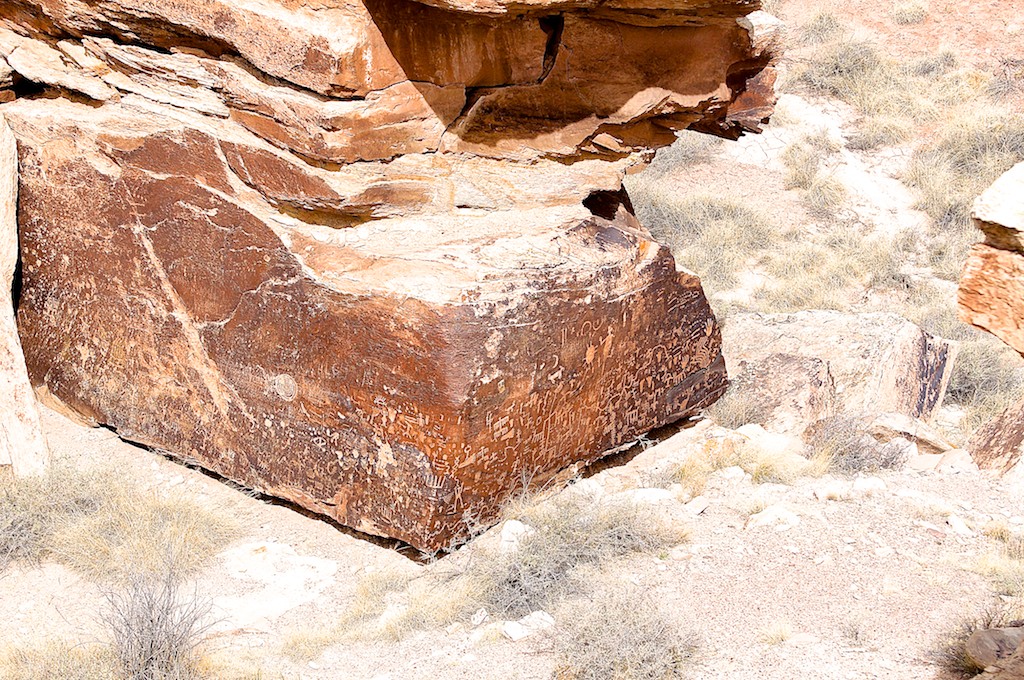
There is a rock which is called “Newspaper Rock” where the petroglyphs are numerous in a reasonably small spot.  The park service does not let you near it, but instead have provided a platform above with fixed binoculars to allow viewing.  Thankfully I have my telephoto lens with me!Petrified Forest  036

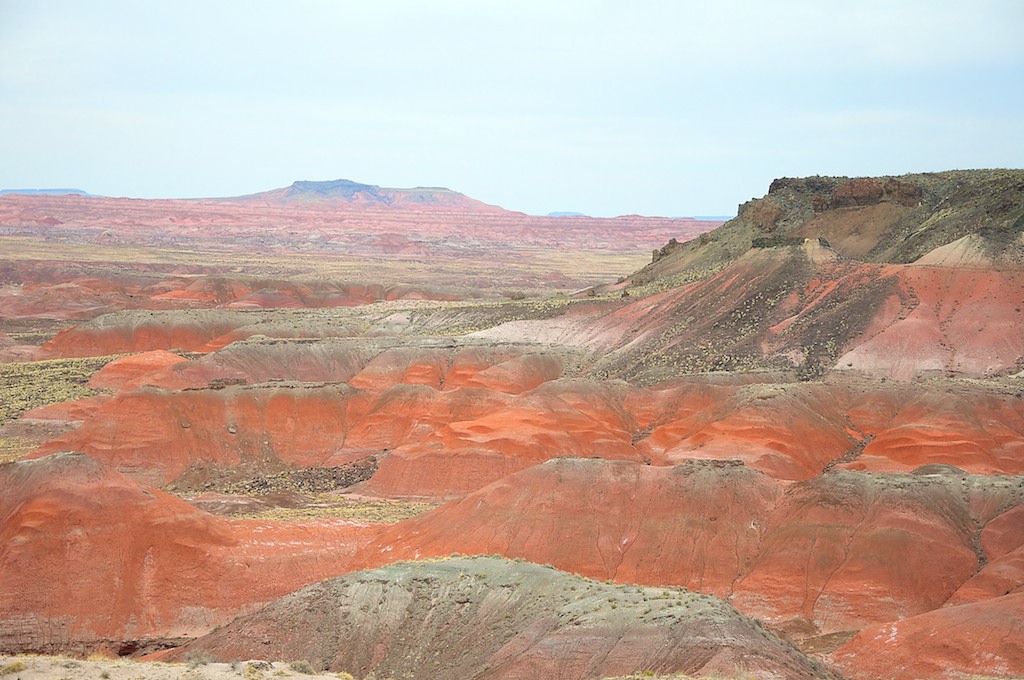
We kept going, and once we had passed over the I40, there were several turnouts that showed various perspectives on the Painted Desert.  What spectacular views!  The colors were the same as in the petrified forest, but were created by the washing to various levels of the layers of sediment.  You’ve got to see the pictures.  The sun was hidden behind clouds, unfortunately, as I suspect the colors would be even more spectacular were the sun available to highlight and contrast.  The sun also creates shadows, which give added depth to the scene.Painted Desert 2  055 Painted Desert 2  053 Painted Desert 2  052

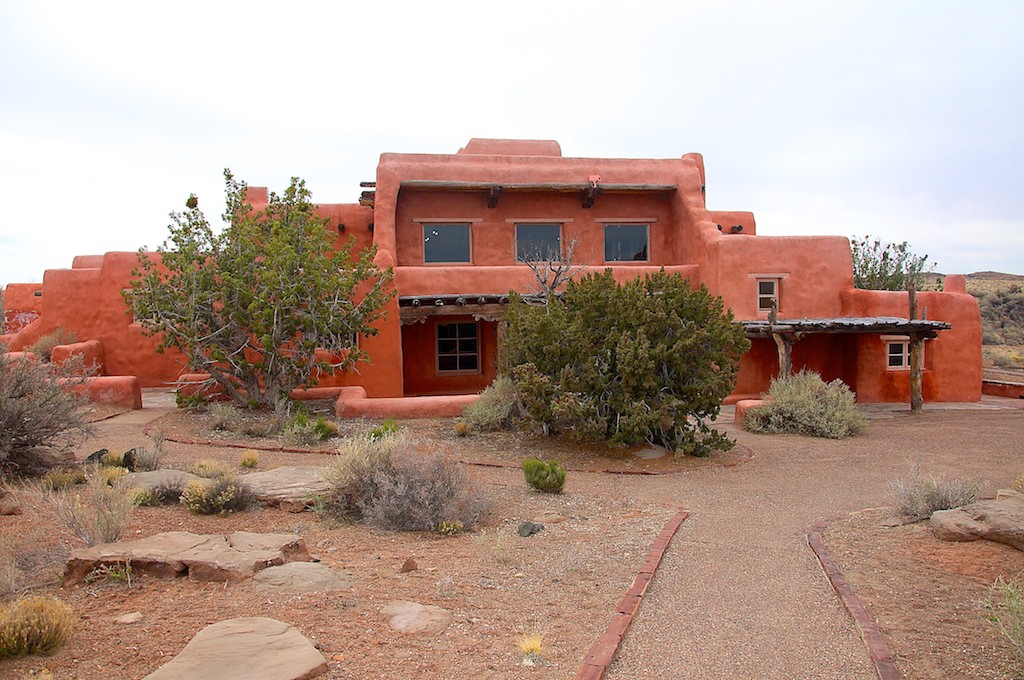
One of the last stops was the old hotel.  Built in the 1890s, and then rebuilt twice, once during the depression using CCC personnel and funding, and the last time in the 1950s, the hotel is in the pueblo style, and is clearly intended to be a site for conferences to take place.  Unfortunately, the building is not suitable for habitation any more, so it is only open for us tourists to take pictures and to go around to the back and view the Bad Lands of the Painted Desert.DSC_0306

New Mexico   075

Entering New Mexico

After that, we went through the exit to the park, and headed out to Santa Fe.  About 75 miles later, we stopped off in Gallup, NM and ate lunch at the local Applebee’s.   The trip through New Mexico was more scenic than even Arizona had been.  On the left hand side for most of the way, were one–after-another peninsulas of higher land, like we were driving through the bottom of a long valley, with the cliffs of the shoreline 1000 feet above jutting out towards us, or occasionally showing us faces which paralleled our progress.  Just like the Painted Desert, the weathered cliff faces showed various strata, colored in a variety of pinks, grays, browns and reds running along horizontally with us.

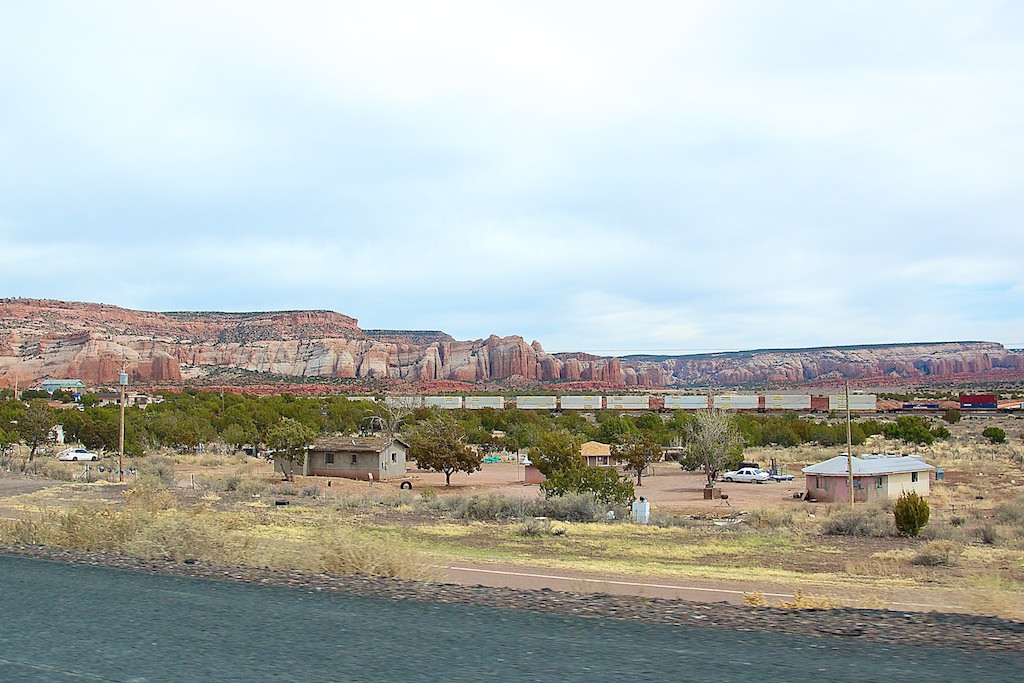
Slowly these cliffs receded, and as we turned north (from the I40 to the I25), they disappeared.  But they provided such a variety of landscape that driving didn’t feel boring at all.  Running along parallel to us, and usually between us and the cliffs are railroad tracks, and we saw a number of trains, sometimes close up to us, and sometimes far, far away – once so small as to seem like they were toy trains that we could pick up at our whim.  The trains were mostly freight of one kind or another; oil tankers in a great line, automobile carriers, but mostly container-car trains.  The trains usually had three engines, but one shorter train we saw had three engines in front and four in back.  We guessed that the engines in back were just being taken to their next job.

We arrived in Santa Fe around 6:30, and without too much difficulty, found our hotel.  This one is the Inn at Alameda, a boutique hotel that is living up to its name.  It is quite well done, and we are enjoying it.

Leave a comment

Filed under Uncategorized

Day 2

Monday March 25, 2013

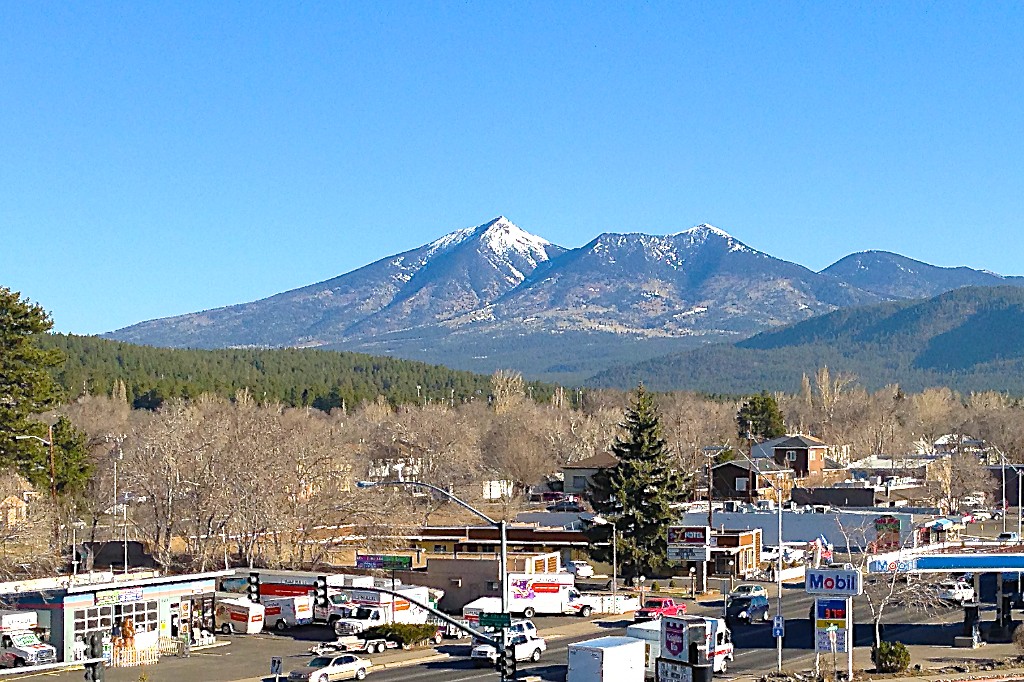
IMG_0228 - 2013-03-25 at 08-11-42

Mt Humphreys as seen from our hotel room.

Today was our day in Flagstaff, AZ.  We first drove around the old-town downtown area, which looked appealing; although it appeared to be somewhat without people early on a Monday morning.  We then headed to Lowell Observatory.  Flagstaff is set in the mountains, and the dominant feature is Mt Humphreys, the highest peak in Arizona.  Our view was of a snow-covered peak, which for Gwen is great — that’s as close to snow as she usually wants to get.

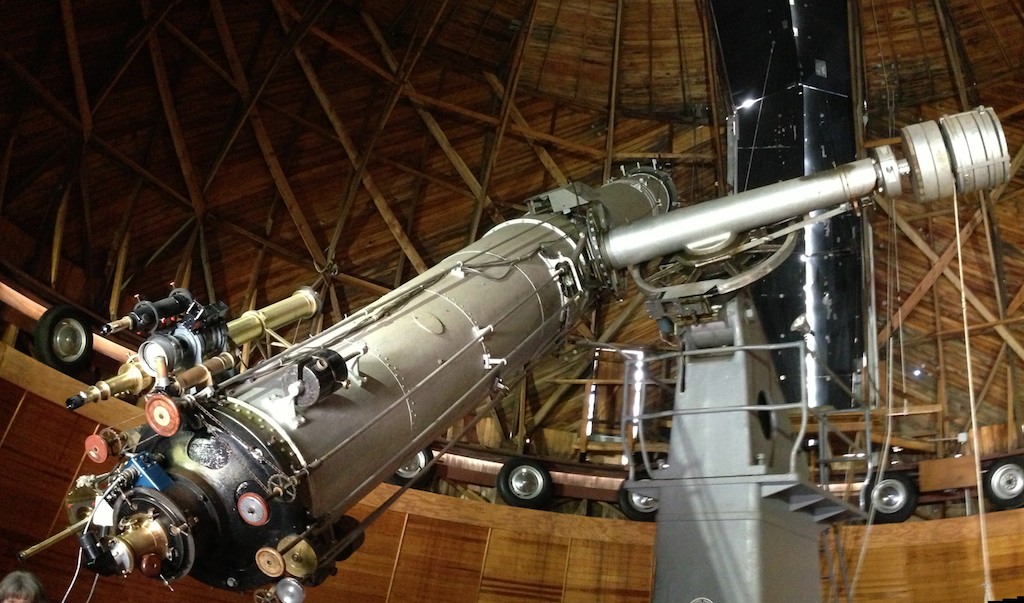
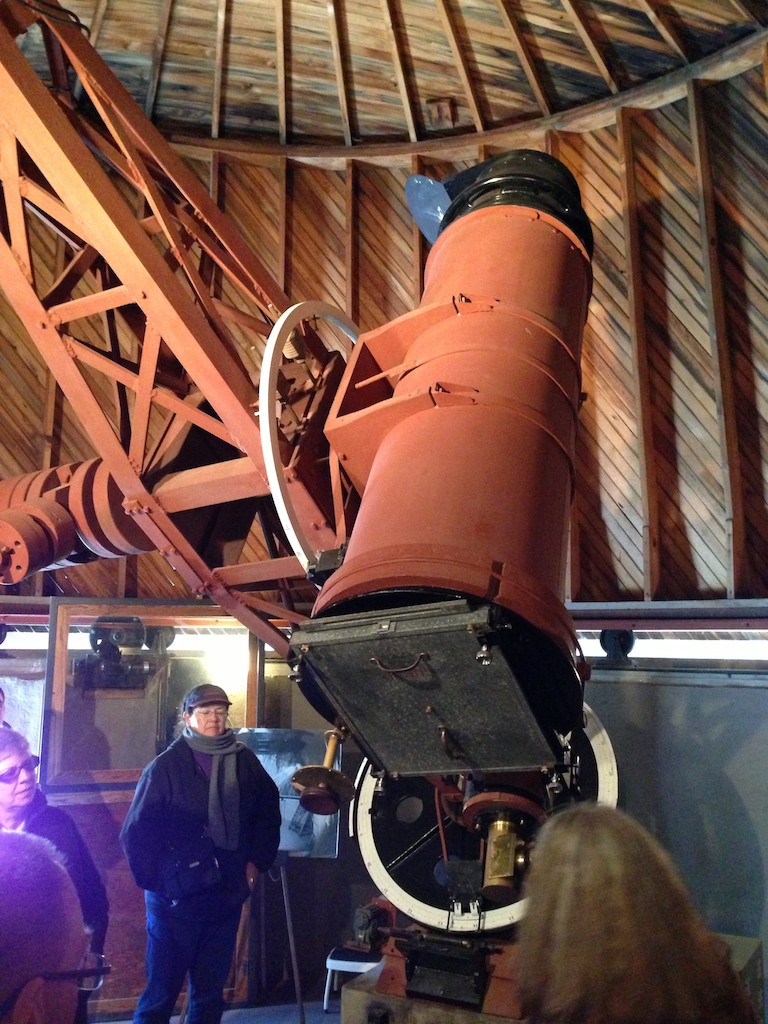
Lowell Observatory was surprising to me, even though I had heard the name before.  I had not remembered anything special about it.  It turns out that this is one of the earlier observatories, put together by Percival Lowell in the late 1800s in the hills above Flagstaff.  He was very interested in whether or not life existed on Mars, so he had the observatory  built housing a 20 foot long tube about 2 feet in diameter, and commenced to make observations.  Lowell Observatory 1  001He kept his records by hand, drawing what he saw of Mars in a notebook.  Later on, the technicians who maintained the place assembled a camera for him which he could attach in place of the eyepiece, and expose glass plates about 8″ by 12″.  The building’s dome is not hemispheric, rather it is close to hemispheric, created by a number of flat faces assembled together.  The support structure would not have been able to bear the weight of a full hemispheric done, we were told.  The end result has virtually the same room as a dome.  There is a set of doors to the outside sky which are operated by a set of ropes and pulleys. The whole structure is resting on a set of what appear to be small automobile tires.   Three motors easily rotate the dome within a circular track to whatever sky angle is desired.  Lowell sat on the ground level, stood, or sat on a chair resting on a horizontal platform between two stairways, which enabled him to see what he wanted through the eyepiece.  The telescope is a refractor, and was installed at the observatory in 1896.

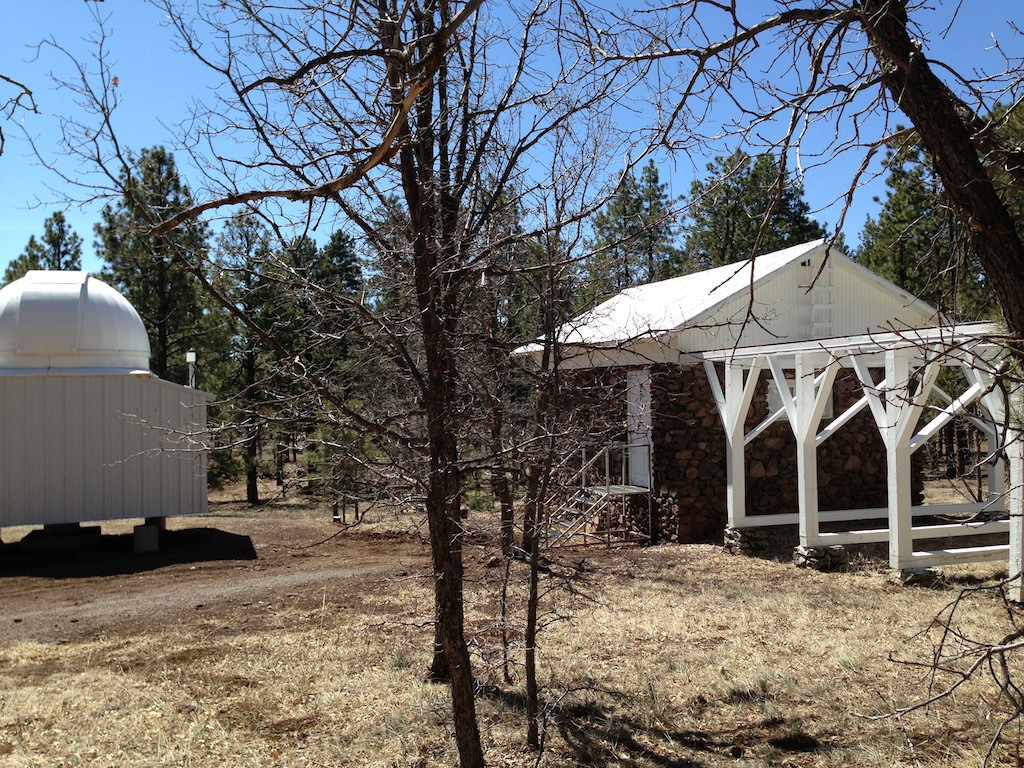
The land where the observatory is located is still in use for astronomical purposes.   Several other telescopes of various types are now established on the site.  Among other things, it was here that the images which enabled Clyde Tombaugh to point out the (now classified “dwarf planet”) Pluto were taken in 1930.  The building holding this photographic telescope is about 100 yards from Lowell’s original observatory in its own building.   Lowell Observatory 1  003 You’ll notice the flat plate at the bottom of the telescope.  This is where the photographic plates were set to expose them by Tombaugh.

There are 20 or more post-docs doing research out of Lowell at any one time, on a variety of subjects.   For example, there is a study going on now concerning stars very similar to our sun with the object of finding them in different ages to see what we can learn about the details of our sun’s future (and past) existence.  Another study concerns the brightness of the reflection of the sun off of the outer planets.  Several of these projects have involved building telescopes of their own, and these days they are getting smaller in scale as the telescopes get more technically sophisticated, and their controls require less and less immediate hands-on monitoring.  Lowell Observatory 1  002   The telescope on the right uncovers itself by shifting the roof from the building to the framework on the right, leaving the entire night sky available for the viewers.  The telescope on the left looks like the original Lowell telescope building, but much smaller, and in fact that is what it is.  We were told the scope opens itself up, and obtains images through the night, available for the review by the astronomer on his computer the next morning.

Lowell has teamed with the Discovery Channel to build a new telescope about 25 miles south of Flagstaff called (not too surprisingly) the Discover Channel telescope, which will (when completed) be the fifth largest such telescope in the contiguous US.  We really enjoyed the pine forest setting of the observatory grounds.  On the site, in addition to the several observatories, is the house Lowell lived in (a museum for the site now), and the purpose-built building for the store, display room, theater and restrooms.

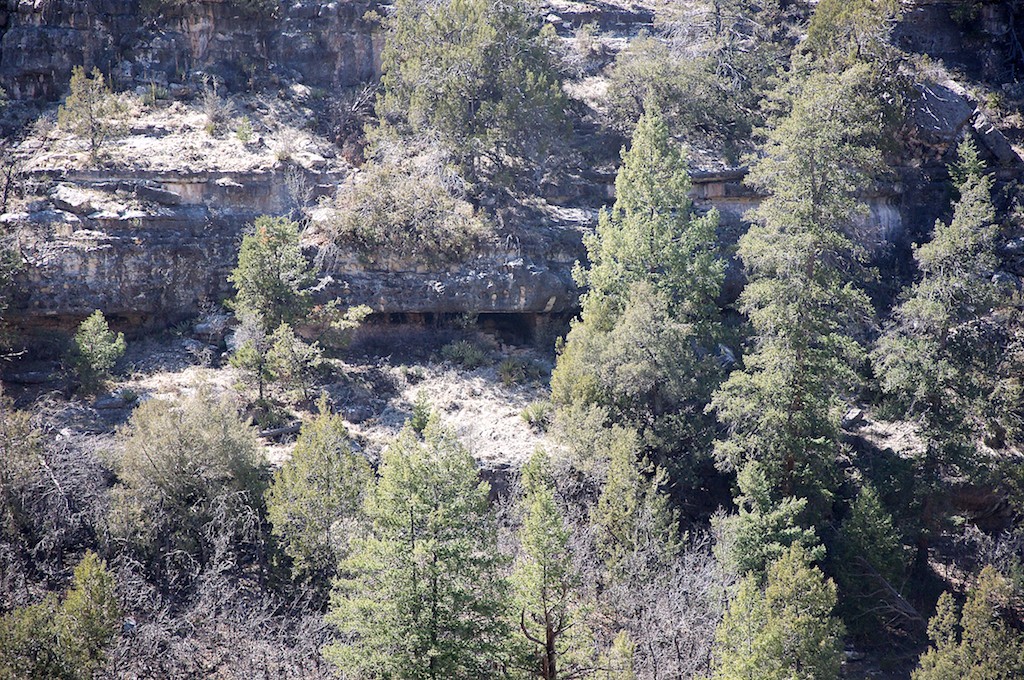
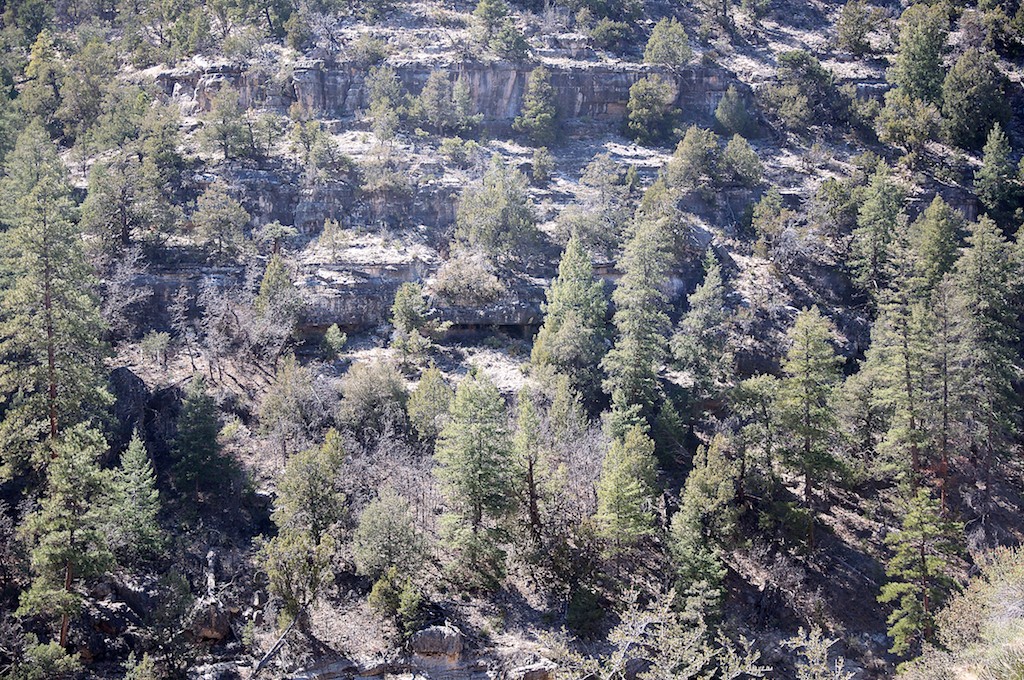
After Lowell Observatory, we went out to lunch, and then on to Walnut Canyon,  a National Park now because it is where the ancestors of Hopi Indians made their home in caves in the convoluted vertical walls of the canyon itself back in the 1100’s.   The park’s main feature is a walk (paved for the most part, with over 260 steps) that enable the visitor to walk down into the valley and around the main ‘island” in the middle of the canyon.  The walk takes you alongside a few of the caves where these indians lived.   Rooms in Walnut Canyon  012 Rooms in Walnut Canyon  001

Note the black smoke on the ceiling.  The walk also gives you a great view across the valley from a number of others.  Rooms in Walnut Canyon  003 Rooms in Walnut Canyon  002 but you have to look closely to see some of them.  Rooms in Walnut Canyon  004

The canyon is twenty miles long, 400 feet deep and ¼-mile wide, and according to the signs, anywhere from 50 to 400 people lived in the caves at their height.  They farmed the flat land at the top of the valley.  The valley verticals provided much in the way of passive defense that was prevalent amongst early cultures (houses on stilts and so on).  The path was a bit of a challenge, mainly due to the altitude, but down and back was less than an hour.  The canyon itself is breathtaking to view, and spectacular to walk!

Leave a comment

Filed under Uncategorized

Day 1

Sunday March 24, 2013

Today was take-off day on our trip back to Michigan.  It was planned to be driving all day, and that is exactly what it turned out to be.  We left the flat we had rented in Palmdale for the last month at 9:15am, dropping some last minute things with Courtney and saying a last good-bye, and then heading north on the  I14 to the I58, and finally to the I40, which is where we spent the most time.  We arrived at our hotel (Drury Inn in Flagstaff, AZ) at about 5:30pm, and immediately went down to happy hour.  Really impressed with the hotel so far.

As the day was spent mostly in the car, we got our travel arrangements pretty well settled.  During the drive, we listened to music from either of our iPhones, or my iTouch.  We have quite a variety, so it was not too bad, at least we were never in danger of listening to the same thing twice.

The scenery was the most fun.  It was desert for the most part, certainly until we were within 100 miles of Flagstaff, when it turned more mountain pines than desert scrub.  The desert in California was remarkably different from that in Arizona.  In CA, the desert had hills or mountains in the distance, and occasionally the hills were jagged on the top; certainly more jagged than the mountains, which appeared more worn down by the weather.  The primary scrub was tumbleweed, although there were a variety of small bushes (which I later decided were probably juniper) and of course the yucca cactus in the higher elevations.  Some of these Yuccas were 9 or 10 feet tall, with spreading branches.  None of the scrub was that big, even the tumbleweeds, getting to no more than three or four feet high.  The western part of the state has a lot of black-on-brown views to it.  The hills seem to be made out of a black substance, with the brown sand (much finer) falling down along the sides.  Where it was near enough to the road for us to see, the black looked like it might have been broken up old road surface, but if that were the overall explanation, there was too much black macadam, and it was spread over too large an area.

In Arizona, the first thing we noticed were the mountain tops, which appear flat on the top in many places, with vertical drops off the edges.  The vertical drops are not flat on the face, but rather look like they are made up of columns gathered together.  I assume this is the result of erosion.  The “columns” do not descend to ground level, but only to a point where sand begins descending at a steep angle, forming a skirt-like surround for the base of the cliff.   The overall impression is one of half-buried Parthenons with the columns all pulled in together.   Sometimes the horizontal veins that are very visible on the columns were parallel with the horizon, sometimes they are at an angle.

The scrub had a lot more variety on the Arizona side, and the bushes, instead of being primarily tumbleweed, were larger and more like evergreens, sometimes huge ball-like bushes of evergreen – as high as the Joshua trees of CA.  These evergreens are probably juniper.

The scenery was quite spectacular, and constantly changing.  It was great!

Leave a comment

Filed under Uncategorized

The beginning . . .

The beginning . . .

Me over-looking Palm Springs!

Leave a comment

April 6, 2013 · 8:08 PM